It usually starts with a small moment of doubt. You climb into the driver’s seat, coffee in one hand, keys in the other. Maybe you are heading to work, running late for school drop-off, or preparing for a long drive across town. You turn the key or press the start button and wait for the familiar sound of the engine firing to life.
Instead, the engine hesitates. It turns over slowly, like it is still waking up. You pause. Try again. The second attempt works, and the car starts. You shrug it off and drive away, but that small hesitation is often your car’s way of saying something important.
Car batteries rarely fail without warning. Most give you several signals before they stop working altogether. The problem is that drivers often ignore those signals until the day the car refuses to start completely. Knowing what those warning signs look like can save you from a much more inconvenient moment later.
The slow start that shouldn’t be ignored
One of the earliest and most common signs of a failing battery is a slow engine crank. When you start your car, the battery sends a burst of electrical power to the starter motor. That power turns the engine over and brings it to life. When the battery begins to weaken, it struggles to deliver that energy quickly, which means the engine takes longer than usual to start.
Instead of a quick, confident start, the engine sounds sluggish or strained. Many drivers notice this once or twice and assume it is nothing. In reality, it is often the first signal that the battery is losing its ability to hold charge.
If your car has started sounding slightly tired in the mornings, it may be time to have the battery checked before it fails completely.
When your car’s electronics start acting strangely
Your battery does much more than start the engine. It powers nearly every electrical system in the vehicle, from headlights and dashboard displays to windows, locks, and entertainment systems.
When the battery weakens, these systems often start behaving differently. Headlights may appear dimmer than usual. Dashboard lights might flicker. Power windows may move more slowly. Even your radio or infotainment system may seem inconsistent. These electrical changes happen because the battery can no longer maintain stable voltage throughout the vehicle. If your car’s electronics suddenly feel unpredictable, the battery is often the first place to look.
The dashboard warning light
Modern vehicles are good at telling you when something is wrong. Many cars have a battery warning light on the dashboard that illuminates when there is a problem with the charging system. This could mean the battery is failing, the alternator is struggling, or there is an electrical issue affecting the system.
Drivers sometimes ignore this warning if the car still runs normally. That can be a mistake.
The warning light is there to alert you before the vehicle reaches the point where it can no longer start. If the light appears, it is worth having the battery inspected as soon as possible.
The clicking sound nobody likes
If you turn the key and hear a rapid clicking noise instead of the engine starting, the battery may not have enough power to engage the starter motor. The clicking sound is the starter solenoid trying to activate, but without sufficient electrical energy to turn the engine over. Sometimes the car will start after several attempts. Sometimes it will not start at all. Either way, it is a clear signal that the battery is no longer performing the way it should.
When jump starts become a habit
Jump starting can feel like a convenient solution when a battery fails unexpectedly, but if you find yourself needing jumper cables more than once, the battery is already telling you something important.
Repeated jump starts usually mean the battery cannot hold charge properly anymore. Even if the car starts again temporarily, the underlying issue remains. A battery that regularly needs assistance is a battery that is ready to be replaced.
What your battery looks like under the bonnet
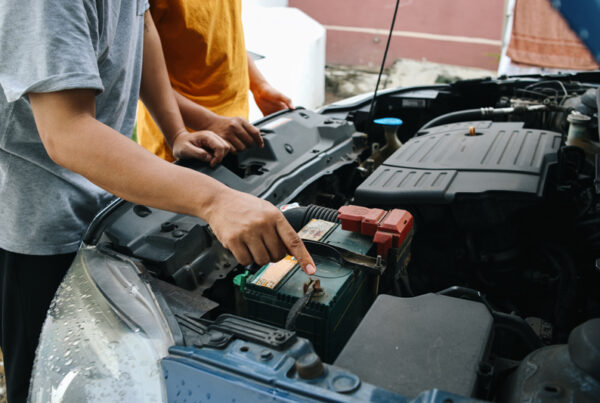
Sometimes the warning signs are visible before they are audible. Open the bonnet and take a look at the battery itself. Corrosion around the terminals often appears as a blue-green or powdery residue where the cables connect. This buildup interferes with the flow of electricity and can reduce battery performance.
Other visual signs are more serious. If the battery case looks swollen, cracked, or damaged, it should be replaced immediately. Heat and internal chemical reactions can cause the battery to expand, which makes it unsafe to continue using.
Unusual smells can also be a warning. A sulphur or “rotten egg” smell may indicate a leaking battery or a battery that is overcharged, which requires urgent attention.
The quiet factor most drivers forget
Sometimes the biggest sign of a failing battery is simply its age. Most car batteries operate reliably for around three to five years depending on driving conditions and climate.
If your battery is within that range and beginning to show small signs of weakness, replacing it early can prevent the far more frustrating experience of being stranded somewhere inconvenient.
After all, a car battery rarely chooses the right moment to fail. It usually happens when you are late, far from home, or parked somewhere you would rather not be stuck.
The simple solution
When the signs start appearing, the smartest move is often the simplest one. Instead of waiting for the battery to die completely, replacing it early restores confidence in your vehicle. A new battery provides the reliable power needed to start the engine and support all the electrical systems that modern vehicles rely on.
Professional fitment also ensures the battery is correctly installed and secured, protecting both the vehicle and the battery itself.
Getting back on the road quickly
Battery trouble does not have to turn into a full day of frustration. Willard Battery Xpress makes battery replacement quick and straightforward. Technicians can assess the condition of your battery, recommend the right replacement, and ensure it is professionally fitted so your vehicle is ready to start when you need it.
Our Battery on Call service is especially useful when a flat battery catches you away from home. Instead of arranging a tow or waiting at a workshop, you can have a mobile technician come to you. By calling 0860 12 00 12, drivers can arrange for a new battery to be delivered and fitted on site, making an inconvenient situation much easier to manage. With the service available Monday to Sunday from 07:00 to 22:00, help is within reach when you need it most.
The truth is simple. Cars are full of complex technology, but none of it works without a healthy battery, and if your car has already started dropping hints that the battery is on its way out, today might be the perfect day to replace it before tomorrow morning’s ignition turns into a guessing game.